
Searching Grand Traverse County Criminal Dockets
Criminal records in Grand Traverse County split across a few doors. MiCOURT Case Search is the statewide starting point. It covers participating Michigan trial courts by name or case number, with filters for criminal category, year, status, date, and public status. Felonies that reached the 13th Circuit Court belong in a different tool: the 13th Circuit criminal search. That index tracks Circuit felonies only, not District misdemeanors.
Give the search your sharpest details. The 13th Circuit form takes a defendant name. Or it takes a case year in ccyy form paired with the case number and a Grand Traverse county selection. Searching a partial last name? Leave the first-name field blank. Online results are informational only, so order any document or certified copy through the Grand Traverse County Clerk.
- Search MiCOURT by name or case number and select a public Grand Traverse criminal result.
- For a Circuit felony, use the 13th Circuit index by name or by year, number, and county.
- Read the court, status, charge block, and newest future setting in the register of actions.
- Use the 86th District Court route for misdemeanors, arraignments, and preliminary examinations.
- Ask the holding clerk for a specific entry, image, or certified record.
Grand Traverse Felony Search Since 1981
Felony cases from 1981 forward sit in the 13th Circuit search. The tool spans Grand Traverse, Antrim, and Leelanau counties. Pick Grand Traverse from the county list. If a felony reached the trial court, its Circuit record should come back. The tool skips misdemeanors, though, and promises neither document images nor a certified copy.
The official criminal-search form is the best first stop for a known Circuit felony in Grand Traverse County. For older felony material that never made it into the index, the Records Office holds microfilm. A blank result can mean several things. It could be an older case, a District Court matter, a nonpublic record, or search terms that were too thin.
Need a person instead of a screen? The Grand Traverse County Clerk's Circuit & Family Court Records Division keeps the Circuit files and registers. Its published Court Records line is 231-922-4710. The Hall of Justice also has a free public terminal. It works well as a Grand Traverse fallback.
The official 13th Circuit search form displays every field a Grand Traverse felony search accepts.
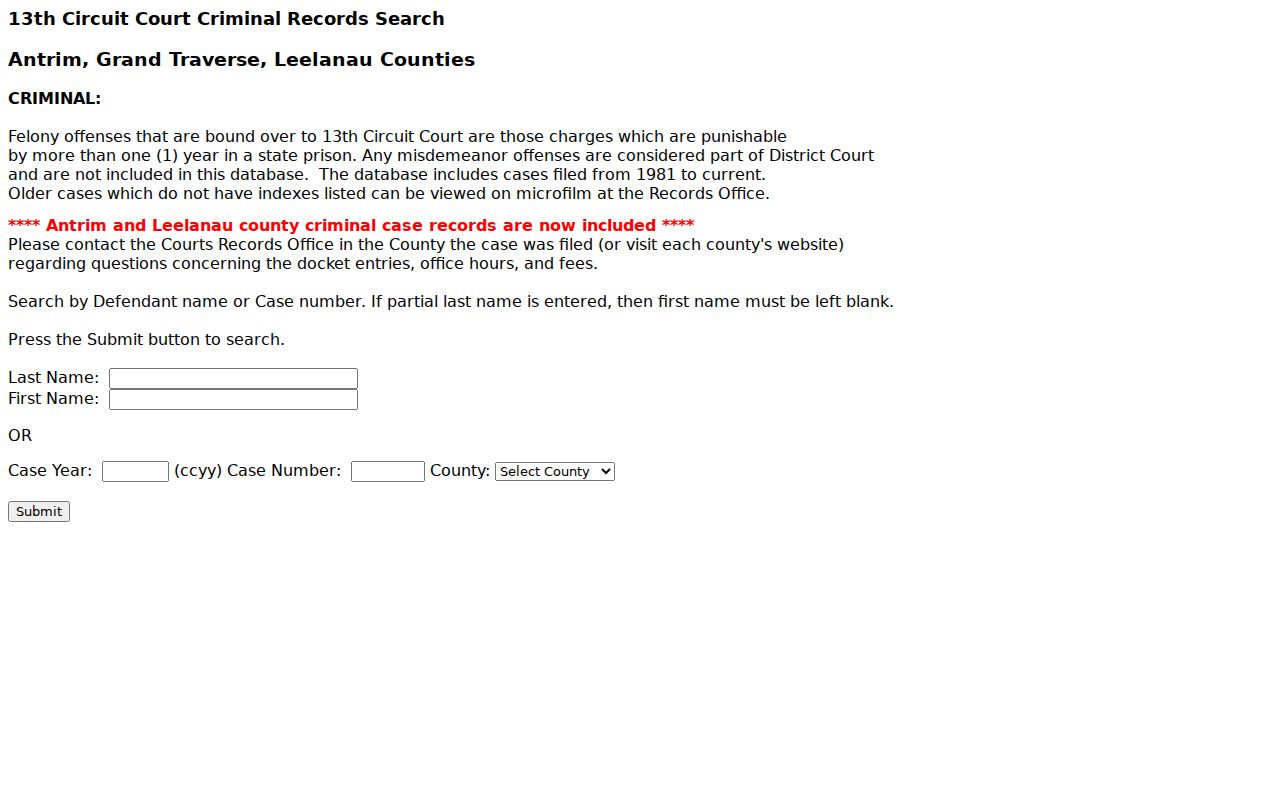
The form itself shows why court level, county, and case year each matter when you run a Grand Traverse felony lookup.
Inside a Grand Traverse County Criminal Docket
Michigan labels a criminal case history a register of actions. Every Grand Traverse County criminal docket follows that format. The record opens with identity fields, then lists court actions by date. Expect the case number, court, judge, and caption. You should also see the filing date, case type, public status, disposition date, and any next hearing. Searches work differently depending on the tool. A name search may surface only the matching participant. A case number search can pull every public participant tied to the matter.
Always read the newest entry together with the entries around it. A charge is an allegation, nothing more. Status words like closed, disposed, open, or deferred never replace the entry that actually explains the court's result. When you need filed documents, a targeted request to the Grand Traverse clerk is usually the route.
| Case number | A court identifier; legacy Circuit searches pair a ccyy year with a number and county. |
|---|---|
| Charge block | Offense, classification, and public charge-level detail where MiCOURT displays it. |
| Case history | Chronological filings, notices, hearings, orders, returns, and court actions. |
| Setting | The next public hearing or dated event, checked against the newest notice or order. |
| Disposition | A court-entered outcome such as dismissal, plea result, conviction, acquittal, or another resolution. |
Grand Traverse Bindover Access Change
A felony in Grand Traverse County can travel through two courts. Arraignment and the preliminary examination happen first in the 86th District Court. If the judge finds probable cause, a bindover moves trial activity up to the 13th Circuit Court. That transfer is not a dismissal. A case that seems to vanish from District Court has simply changed addresses.
The rules on access changed for cases bound over on or after July 2, 2024. Under Michigan Court Rule 8.119(H)(10), District case records become nonpublic after bindover. The Circuit record stays open. A disappeared District docket does not mean the charge ended. Check the 13th Circuit portal instead, or ask the Grand Traverse County Clerk for the authorized route.
Access rule: MCR 8.119 provides public access to case records while allowing protection of nonpublic material and personal information.
Administrative Order 2006-2 limits release of protected personal information.
How a Criminal Case Moves
A Grand Traverse criminal docket tells the story of a case step by step. It can open with a complaint, a warrant, or a first appearance. From there, expect entries for arraignment, bond, and lawyer activity, plus a preliminary examination, a waiver, or a bindover. Once a felony reaches Circuit Court, the court record picks up motions, pretrial settings, a plea, trial, sentencing, and any post-judgment filings that follow.
Case-history flow: Filing › Arraignment › Pretrial › Plea or Trial › Disposition › Sentencing.
A few common terms explain most docket entries. Bindover is the transfer that follows the preliminary process. A set-aside gets redacted from public history, and bond forfeiture is what the court does after a missed appearance or a broken bond condition. Whatever the label, the exact Grand Traverse entry, its date, and its court tell you more than any shorthand status ever will.
Grand Traverse Zoom Arraignment Settings
Grand Traverse arraignments start through Zoom, per the 86th District criminal FAQ. Sessions run at 9 a.m. Monday through Friday, with in-custody arraignments at 1:30 p.m. Participation follows the court's notice and its supplied link. A public calendar display can flag a scheduled event, but it never replaces the notice or the case register itself.
The FAQ also walks in-person appearances through the building. After security, people with Grand Traverse criminal matters check in with Criminal Records through the double doors on the lobby's left side. The clerk confirms address details, points you to the courtroom, and can identify a record path or setting. Staff cannot give legal advice, though.
Call the 86th District Court at 231-922-4580 when an online entry confuses you. Circuit settings run through the 13th Circuit Court Administrator's Office, while the Grand Traverse County Clerk keeps the case history and file.
Courts That Hold Criminal Dockets
Two courts split the Grand Traverse criminal docket. Misdemeanors, traffic-criminal matters, felony arraignments, and preliminary examinations all land in the 86th District Court. A felony that binds over moves to the 13th Circuit Court for trial. One wrinkle worth knowing: the District Court runs a Domestic Violence Court docket for qualifying misdemeanor domestic-violence charges. It covers Antrim and Grand Traverse counties. It is a docket division, not a separate court.
Grand Traverse Recovery Court sits inside the 86th District criminal and traffic system. The underlying case history stays public. Treatment and review material can carry access limits. The county publishes no full eligibility checklist and no program length. So do not read either detail into a docket entry. For the bindover route, the official Criminal Division page lays it out. It covers the preliminary process too.
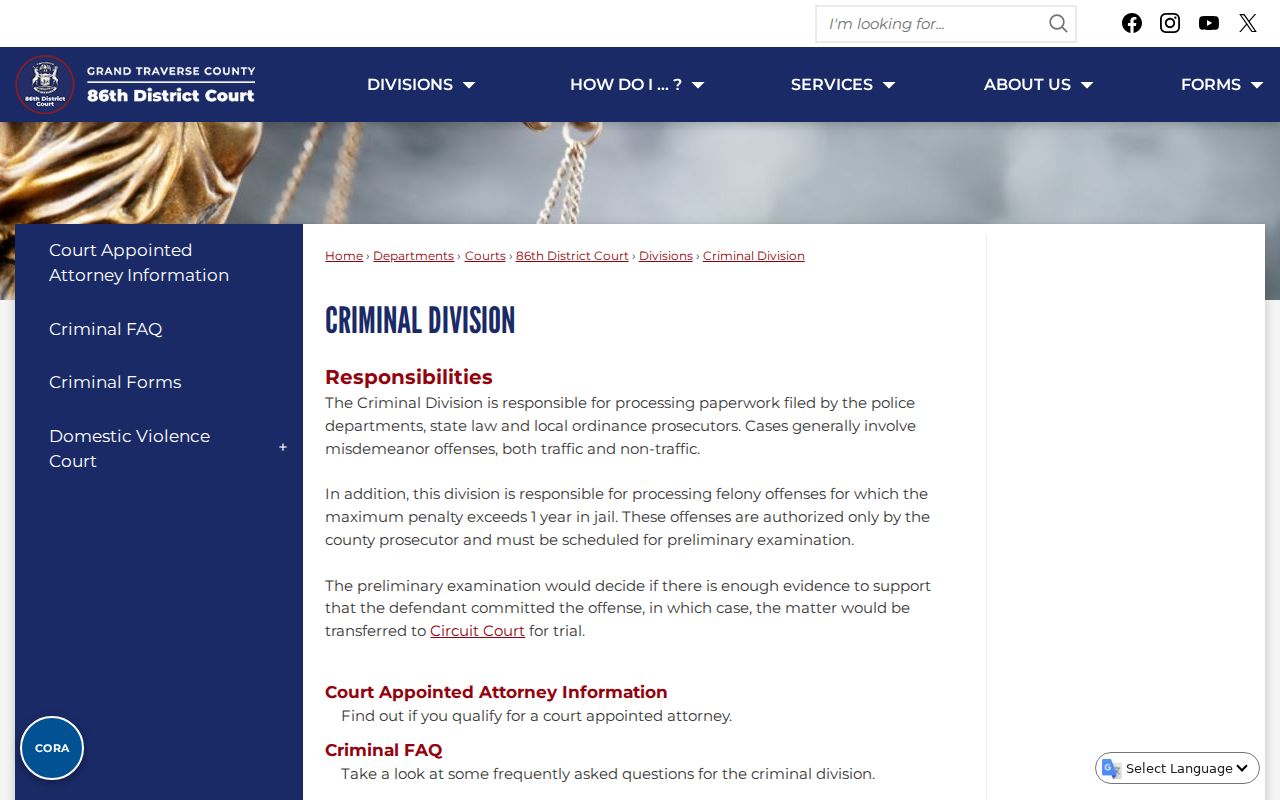
That published description helps place an 86th District entry before a Grand Traverse felony reaches Circuit Court. The Recovery Court source ties the program to the Grand Traverse criminal and traffic system.
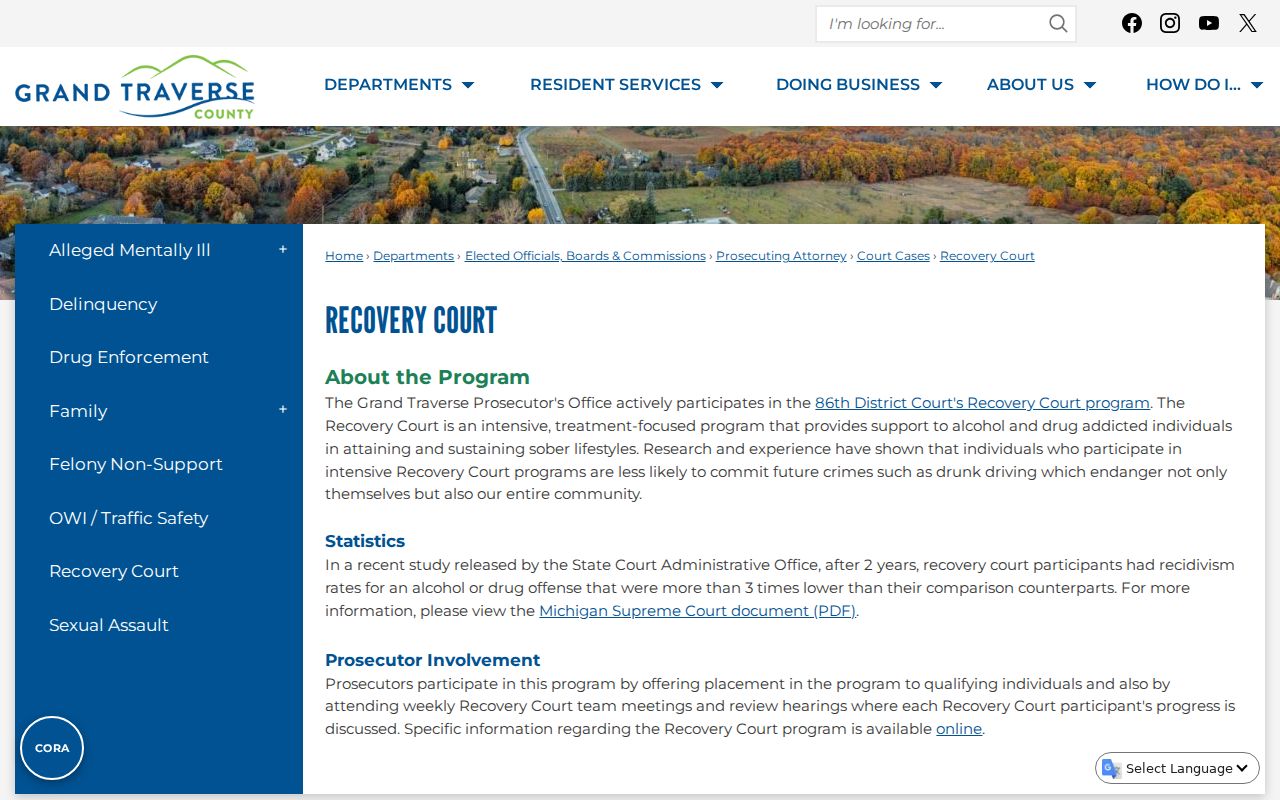
The Recovery Court material keeps the underlying Grand Traverse criminal case history as the starting record. For a different model, the Community Outreach Court guidelines describe a separate collaborative review process.
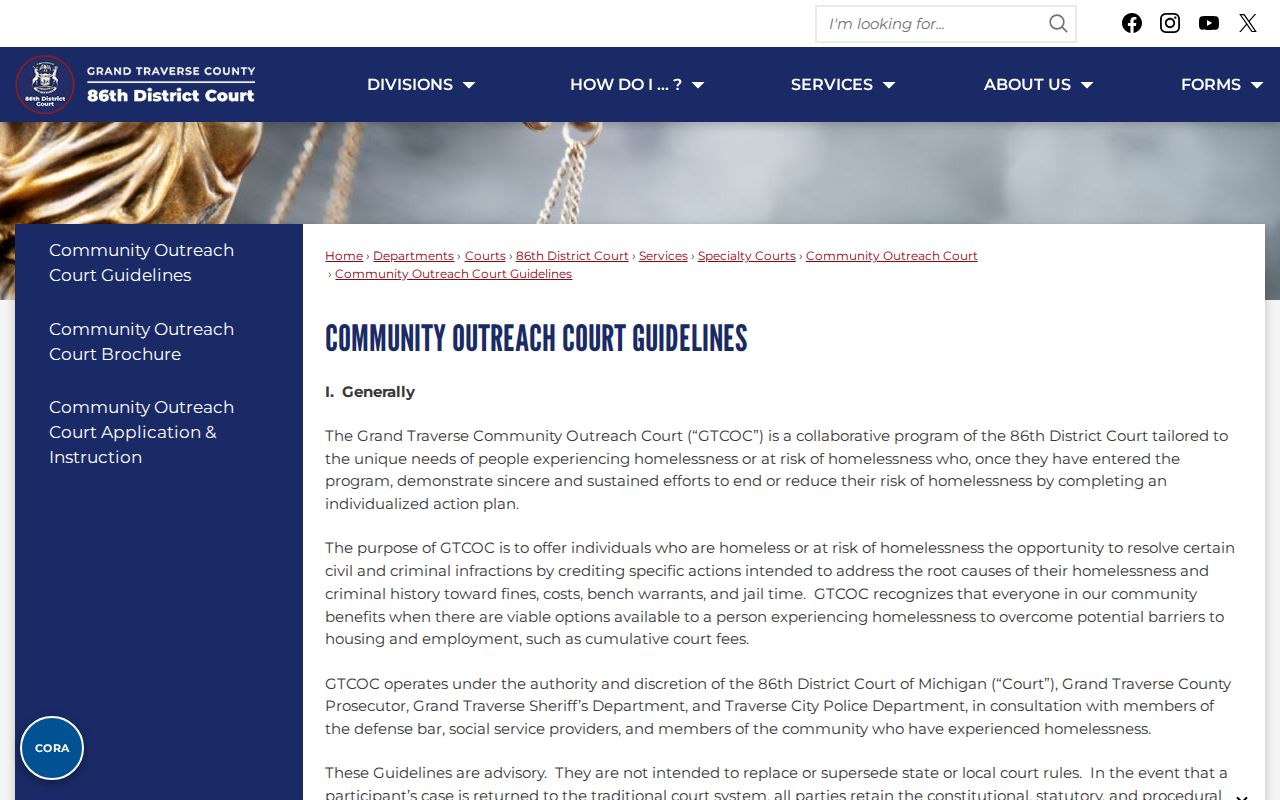
The guidelines set out confidentiality policies. A Grand Traverse public docket will not spell out program details.
Grand Traverse Criminal Search Gaps
One gap matters here. The 86th District Court has paused extracting criminal cases to its public website while records are reconciled. Civil infractions remain viewable and payable. For eligible payment or limited case lookup, the county points to the Grand Traverse WebTecs portal, which searches by case or ticket number, or by first and last name with date of birth for your own case.
WebTecs is not a full criminal register. Updates may lag until the next business day, nonpublic cases cannot be paid online, and payment after 3:45 p.m. posts the next business day. If a Grand Traverse criminal record does not appear, call the District Court, use the public terminal, or request the specific case file. An empty screen proves nothing about the outcome.
Sealed Dockets and Public Access
A Grand Traverse public criminal case history can list the case number, court, filing date, public parties, judge, status, chronological entries, settings, and disposition. It is an index of events. It does not promise every filed image or protected detail will appear online.
Juvenile matters, protected family material, personal identifiers, sealed records, and set-aside convictions skip the ordinary public-search path. MiCOURT also warns that some courts show criminal-conviction information only for seven years after sentencing. A blank result may reflect a restriction, a set-aside, or the District extraction pause. Another court may hold the record.
The Grand Traverse County Clerk takes targeted court-record requests by mail, email, and in person. Include the party name, case number, and document title or date. Add a return address. The clerk decides the process for protected records and redactions.
Grand Traverse Criminal Docket Volume
The state judicial-resources report counts 396 Grand Traverse 13th Circuit criminal filings for 2024. That number is one slice of a bigger system. The same local courts also handled District traffic and civil-infraction cases. Family matters and Probate filings were there too. For a real docket search, court, case type, and case number work best. They beat a broad name search every time.
The SCAO judicial-resources report measures workload, not cases. For a particular Grand Traverse matter, the current register and the holding clerk remain the path.